
Chat with us
1

Beyond the Floor Plan: Why Architectural Sections are Vital for Project Success

5 min read
Beyond the Floor Plan: Why Architectural Sections are Vital for Project Success

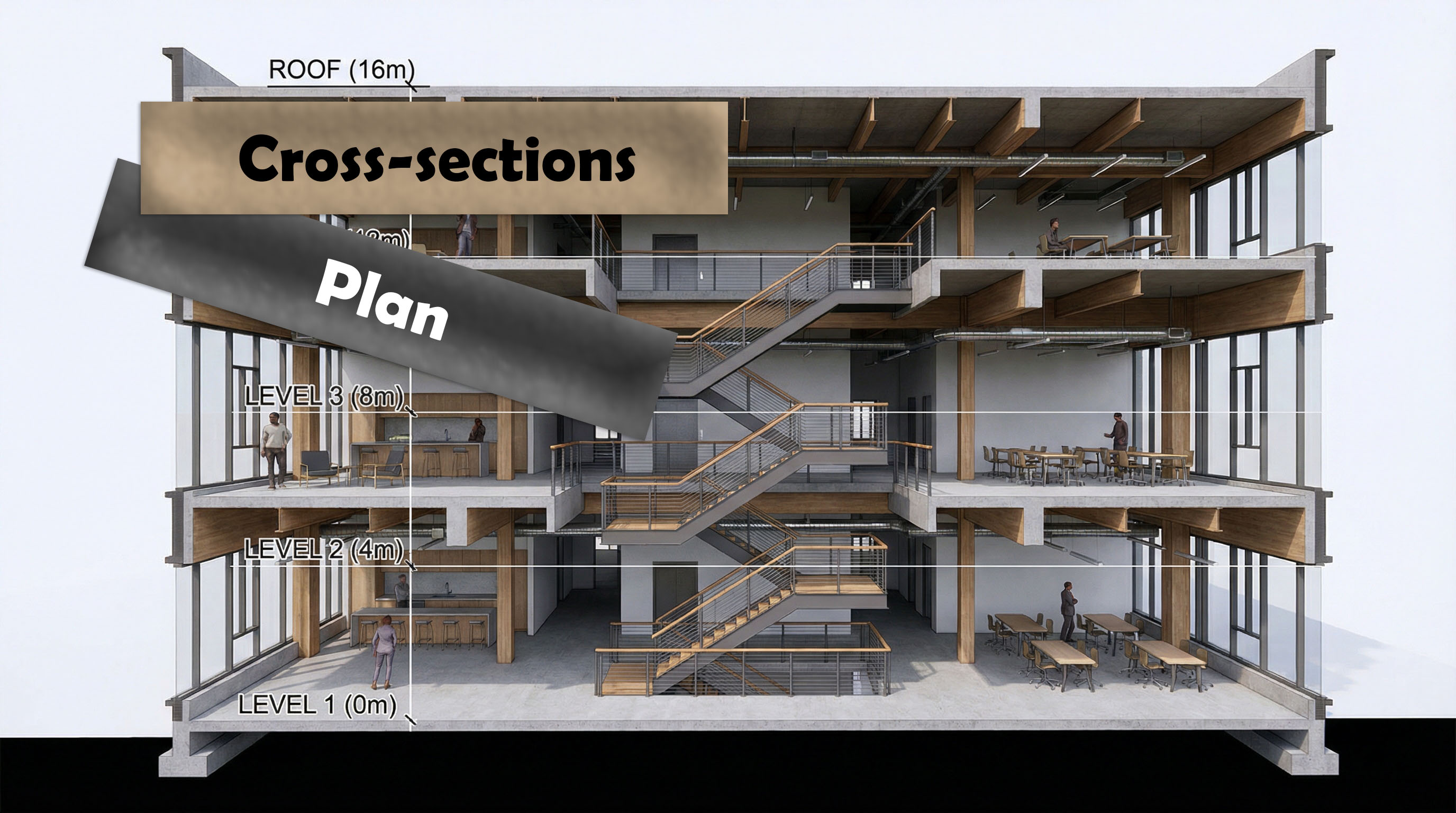
When we think of architectural drawings, the "Floor Plan" is usually the first thing that comes to mind. However, a floor plan only tells half the story. To truly understand the volume, height, and technical complexity of a building, we must look at the Sections (Les Coupes). A section is a vertical "cut" through the project that reveals its internal life. At Buildmodeler 3D, we utilize 3D Modeling to transform these technical slices into immersive views that ensure every vertical detail is perfectly engineered.

What is an Architectural Section? A Section is a fundamental technical document used throughout the DPC and DCE phases. It provides crucial information that a horizontal plan cannot show:

1. Level Heights (Les Hauteurs): Defining the exact distance between finished floors, the height of ceilings, and the total elevation of the building.
2. Structural Thickness: Showing the layering of slabs, insulation, and flooring materials.
3. Complex Architectural Elements: Detailing vertical features like staircases, indoor gardens (Jardinières), balconies, and double-height voids.
4. Technical Integration: Visualizing how pipes, air conditioning ducts, and electrical trays fit within the ceiling and floor voids.

The Challenges of 2D Vertical Thinking In traditional 2D drafting, sections can be difficult to interpret for non-professionals. A "Jardinière" (planter box) on a balcony might look like a simple rectangle on paper, but in reality, it involves complex drainage, waterproofing, and structural support. If these vertical relationships are not clearly understood, they lead to major errors during the execution (EXE) phase on-site.

Why 3D Modeling is Essential for Architectural Sections Integrating 3D Modeling into the sectioning process is a game-changer for clarity and precision:

5. Instant Volumetric Understanding: In a 3D model, we can cut a section anywhere in the building instantly. This allows the owner to "see inside" the walls and floors. You can understand the spatial relationship between a balcony and the garden below, or how a recessed ceiling interacts with the lighting.
6. Solving Complex Junctions: 3D modeling allows us to rotate the section and view it from any angle. This is vital for complex areas like stairwells or indoor gardens, where multiple materials and structural levels meet. We can solve these "3D puzzles" digitally, ensuring they fit perfectly when built.
7. Accuracy of Levels and Heights: Human error in calculating heights is a common cause of construction delays. By extracting sections directly from a coordinated 3D model, we ensure that every height shown is 100% accurate and synchronized with the floor plans.
8. Visualizing Light and Airflow: Sections are the best way to analyze how natural light enters a building. In 3D, we can simulate sun angles to see how light reaches the back of a room through high windows or skylights, optimizing the building's energy efficiency and comfort.

Conclusion The Architectural Section is the bridge between a flat idea and a three-dimensional reality. By leveraging Advanced 3D Modeling, you transform a technical drawing into a powerful tool for visual clarity and engineering safety. It provides the contractor with an indisputable guide for heights and the owner with a breathtaking look into the heart of their future project.

Discover more articles

Explore our collection of articles on 3D modeling and architecture.